Monday, April 16, 2012

Module IX - Alaska Governance and Contemporary Issues

Essential Question:
Alaska National Interest Lands Conservation Act 1980 has been supported and derided by Alaskans, both in 1980 when it was passed and today.  Describe three impacts of this landmark legislation.


National Conservation Areas in ANILCA
The Alaska National Interest Lands Conservation Act (ANILCA) was passed in 1980. It set aside 104 million acres of federal land in Alaska under the status of monuments, preserves, and wildlife refuges as well as adding to the national park and national forest systems. It is also considered the last major land act for Alaska. The implementation of ANILCA has given ownership of 60% of Alaska to the federal government. Most of this land is in conservation reserves that are off limits to most economic development. The government regulates mining, cabin building, road/trail building, use of motorized vehicles, use of tools, hunting, fishing, and recreational activities. It provides protection to a significant area of the state previously open to mining and other kinds of entry. In all of these areas, wildlife, water and land resources are more fully protected than ever before. For a list of these areas, you can visit this site.


Exxon Valdez Oil Spill Cartoon
Conservationists in America were happy at first, that is, until they began to carefully review the bill. They were disappointed because Senators Stevens and Gravel and Congressman Young wrote a lot of exceptions into the act. Some of them included drawing boundaries around lands of economic potential, which excluded them from the conservation units, ecosystems were cut up or incomplete, and lands that were wanted to be named as parks were named as preserves. Preserves allow sport hunting and other kinds of activities that were banned from the Lower 48 parks.


Snow machines, motorboats, and floatplanes, as well as high-profiled rifles, chain saws, and cabins would be allowed in areas called “wilderness”. The act also allowed prospecting on most land known to have mineral or oil potential. It guaranteed access by floatplane, motorboat and snow machine to millions of acres. Access was guaranteed in holdings in the national parks and refuges. Access was also protected to state lands and waters that lie within federal units. After reviewing the exemptions, some critics wondered if it could be called a conservation act at all. However, it did provide a framework for preservation in Alaska.


Subsistence Fishing
ANILCA also impacted the issue of subsistence. Title VIII of ANILCA granted a subsistence priority for rural residents at any time of inadequate resource availability. The state of Alaska had to enact the subsistence priority law that would align with ANILCA in order for the federal government to grant Alaska the management of fish and game on all Alaska lands. However, in 1982, Proposition #7 was introduced and sought to overturn the subsistence law by citizens initiative. This proposition was defeated. There were several court cases battling the subsistence priority law and eventually, in 1989, it is found that the state had failed to amend the state constitution and the Federal Government took over the management of Federal lands. They also took over fisheries and federal waters in 1999 creating a dual system of fish/game management in Alaska.


Harbor seal
Albert Howard dresses a harbor seal he shot for subsistence in Angoon. PHOTO BY MICHAEL PENN


Examine:
Identify the Alaska Senate and House Districts in which you live (Use current, not pending, letter and number.) Identify the name and political party of your state senator and representative.  Identify the type of local government you have (city? borough? what class?)  Identify the tribal government, if any, in your area, and if possible find out if it is an IRA or traditional council.


I live in Eagle River. The House District is 17 and Senate District I. Anna Fairclough is the current Representative and is a part of the Republican Party. Fred Dyson is the Senator and is a part of the Republican Party also. Eagle River is a City in the Borough of Anchorage.


Anna Fairclough
Fred Dyson


Alaska Native Corporations
The Anchorage area has the Cook Inlet Tribal Council (CITC). It was established in 1983 and serves more than 12,000 people each year through programs in eight different areas:
1.    Helping hands
2.    Nurturing Families
3.    Supporting Youth
4.    Growing Graduates
5.    Developing Skills
6.    Finding Jobs
7.    Promoting Business
8.    Achieving Sobriety
To see descriptions, please visit this page.


CITC values are interdependence, resilience, accountability, and respectfulness. Their mission is to “Work in partnership with Our People to develop opportunities that fulfill Our endless potential.” Their Vision: We envision a future in which all Our People – especially Our youth, the stewards of our future – have access to vast opportunities, and have the ability, confidence, and courage to advance and achieve their goals, infused with an unshakeable belief in Our endless potential.


One Hand Reach.1
One Hand Reach


They run the Junior Native Youth Olympics (JNYO), which happens in February for children in grades 1-6. They also run the Native Youth Olympics (NYO), which is going to be held from April 27-29th in Anchorage. Here is the site for the NYO games. I am excited for this because I am volunteering during the games this year and it’s my first year going to the games.


Evaluation:
WOW! That was a lot of information. Anything to do with govenment doesn't really hold my interest. However, it was an ok read for me. I like looking up my own city government. If it hadn't been for this class I would never have looked at any of it. I have been pretty involved with some things run through the CITC. It's been very interesting.

Reviews:
Tina did a nice job of describing the land-lease ALSIB project.

Brad did a nice job providing a variety of pictures and information in his blog.

Heather has a very visually appealing blog. This is the first time I've visited her page and am very impressed. She also has a lot of good information and links.

Saturday, April 7, 2012

Module 8 - WWII 1939-45 A Turning Point for Alaska

Essential Question:

•    Describe the legacy of World War II for Alaska.  What happened in Alaska after the war that is largely attributable to WWII?  What are Alaskans living with today that is attributable to WWII?


Military/National Security:


Whittier Military Tower
After WWII, the military sites were being decommissioned and plans were made to reduce the presence of the military in Alaska. That is, until the start of the Cold War. Alaska was a very strategic place to have a military presence during the war because of it’s location. The Air Force took over several Army bases. Distant Early Warning (DEW) system of radar sites was established and linked to the White Alice. This added high-tech listening and viewing stations along the coastline.


The Alaska Territorial Guard, put into place in WWII, was incorporated into the Alaska National Guard. The ANG is common for both men and women from rural Native communities. ANG provides education and training opportunities. They have been called to assist during long periods of extreme cold and snow. They have also served in both Iraq and Afghanistan.

Infrastructure:

Alaska Highway
Construction projects that came about during the war continued after word. The Alaska Highway provided a way to get to Canada and the lower 48. It is still well traveled today. Other infrastructure projects included:
-    Dock facilities
-    Runways
-    Housing
-    Power stations
-    Military bases: Some military bases that are no longer in use by the government are used by civilians.


Quonset hut
The Quonset hut is a prefabricated building introduced during the War. They were used for housing, warehouses, rec and dining halls, and offices. After the war, they were converted into many different uses. They can still be seen today in certain parts of Alaska.


Political-economic:

Local economies where there were military bases did much better than those who did not have bases. After the war, Alaskans took civilian jobs on bases. The scope of operations is still significant in Alaska’s economy and population dynamics. Military men started to bring their families up to Alaska and this impacted schools, churches, and civic organizations. Others moved to Alaska because they were drawn to the adventure it has to offer, work and land under an Alaska homestead act.


alaska statehood signing
Signing of the Alaska Statehood Act
There were many people who wanted to see what Alaska had to offer them. They were not prepared, however, for life in a territory. They were not represented in Congress and did not vote for governors. They did have a representative in Congress but he had no voting power. Veterans who served in Alaska became advocates of statehood. In 1959, Eisenhower signed the Alaska statehood bill. 


Socio-cultural:

Unalaskan families at Wrangell on their way to Burnett Inlet camp. Courtesy Gert & Sam Svarny Collection
Unalaskan Families
There were many socio-cultural happenings after the war. The survivors of Attu were relocated to Atka. There were many villages in the Aleutians that were never reestablished and some of them moved to Anchorage or Seattle. Those people who decided to move back to their villages found them pretty much destroyed. Native allotments in other parts of Alaska were taken over for military use and are still being fought for to this day.


The Native Civil Rights Movement started back in 1867. From that time up to WWII, Alaska Natives acted to assert their rights to traditional lands, access to resources, citizenship and voting rights. During WWII, the Natives served in the military, which they had hoped would demonstrate their loyalty to Alaska. Because of this action, they expected equal treatment and resolution to outstanding land issues.  In 1945, with the help of Elizabeth and Roy Peratrovich, the Anti-Discrimination Act was introduced. This helped the Alaska Native Claims Settlement Act of 1971 to come about.

Environmental:

st_lawrence_island_slide
Former St. Lawrence Military Base
After WWII, as stated above, bases were closed down. However, there were equipment and supplies left behind at these bases that caused, and are still causing, harm to the environment. Equipment and supplies that contained hazardous chemicals such as polychlorinated biphenyl (PCBs), fuels, solvents, pesticides, and heavy metals were among the items left. Several of these sites are near Native communities and traditional fishing and hunting areas. Two of the most contaminated sites are in Northeast Cape and Gambell on the St. Lawrence Islands.


In the Norton Sound region, bases were mostly built for communication operations. PCBs were used in transformers and other electrical equipment. PCBs entered the marine and freshwater environment affecting the fish and marine mammals, most of which Natives used for subsistence. The military has spent millions of dollars to help clean up what was left behind but there is still a lot to be done.


http://www.akaction.org/Tackling_Toxics/Alaska/Images/Military_Waste_Images/military_waste_400.jpg
Military Waste
Alaska has also been used as an experimental testing ground for the military’s nuclear, chemical, and biological warfare programs. Weapons testing ranges encompass an area approximately the size of the state of Kansas. Alaska is perceived as remote, with small populations of isolated communities that lack the political clout to resist the intrusions.


Eagle River Flats
One thing I found interesting was that the environmental effects also affected the Eagle River Flats. I live in Eagle River and was not aware of this. The Eagle River has been used by the Army for decades to test weapons and some of those weapons contained white phosphorus. It is one of the most polluted sites in the nation. It is now a part of the Fort Richardson National Priority List. Contamination and continued munitions testing threatens waterfowl, endangered beluga whales, and human health. This website gives information about what is being proposed by the army today and a timeline of what has happened  since 1994.


Examine Question:
Describe the major events in the Aleutian Campaign of World WarII.


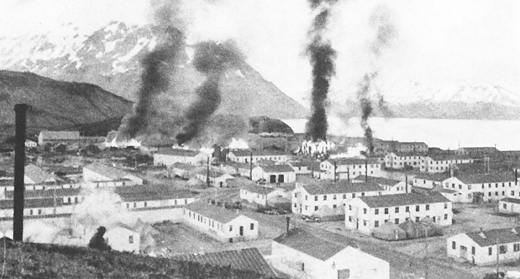
Burning buildings at Ft. Mears
after first enemy attack on
Dutch Harbor, 3 June 1942
In 1942, the Japanese bombed Dutch Harbor to try to create a diversion from the Midway battle. While doing so, Japanese troops occupied Attu and Kiska in the Aleutians. The U.S. Army was unable to force the Japanese off the islands. The Japanese captured weather observers on Kiska and Attu Island villagers and took them to Japan. They stayed there until the war was over. Seventeen of them died while being held captive. The invasion also lead to the evacuation of the Aleuts by the Americans. They were evacuated to Southeast Alaska and given abandoned canneries, old mining camps, and other lactations to live in. Their homes were burned to the ground so they were unusable by the Japanese. Many of them were not able to return to their homes because of this.


This was the second time in U.S. history that American territory had been occupied by an invading army. Efforts to drive the Japanese out started immediately. Japanese reasoning for taking the islands was to have bases for long-range sea planes in order to detect American activity. They also believed that the islands would block any American attack on the Japanese islands. The U.S. believed that the Japanese took control in order to have a shorter distance to fly to bomb the aircraft plants and navy yards around Seattle.


Japanese officers at the Aleutian Islands, circa 1942-1943

The U.S. effort to take back the islands started with bombing raids on the islands carried out by navy flying boats, or large seaplanes, and army air force bombers. The Japanese suffered a great loss. American submarines were attacking Japanese ships that were carrying arms and supplies to Attu and Kiska. They were attacking from the air and water at the same time.


Massacre Bay, Attu, Aleutian Islands, 13 May 1943
The Battle of the Commander Islands happened in March 1943. The U.S. Navy intercepted Japanese ships attempting to take more troops to Kiska. The Japanese retreated. In March of 1943, military officials authorized the retaking of Attu. In April, the invasion force arrived in Alaska from the West Coast ports. These troops had been training to fight in Africa but orders had changed. They were not told where they were going but some believed they were going to Hawaii. They were dressed in summer uniforms and some not given anything extra for the cold weather because it was thought it would weigh the troops down. They attacked on May 11 and the battle lasted until the 29th. The Americans had taken back Attu with over 2,500 casualties and almost 1,200 wounded. Just under 2,000 soldiers died because of inadequate dress for the cold elements. Of the 2,400 Japanese, only 29 survived.


Ready to move against Kiska in 1943


 The recapture of Kiska was next. Runways were built on Attu and bombing raids intensified on Kiska. The Japanese made an escape off the island in July of 1943 and managed to get all of their troops off the island. The U.S. still invaded with the assumption that the Japanese had moved inland. They ended up killing 100 of their allied forces.


This site gives a very detailed account of what happened in the battle over the Aleutian Islands. The History Channel also has some really good videos to watch about the battle. I wasn't fully aware about this battle until I started researching it. It makes me proud as an American to see that we have always been a force to recon with. And to see the sacrifices made in order to keep this country free from invasion. It also saddens me to thing that the military would send in troops poorly equiped for the elements because they thought it would weigh them down. You would think they would have wanted them to be able to fully function during battle and not have to worry about how to keep warm.

Evaluation:
I liked reading all of this information and finding diferrent resources to help me answer the questions. It was interesting to learn how the actions of WWII affected life afterwords. I also learned a lot about the battle over the Aleutian Islands and how it came about and the impact it had on not only the military, but also the people of the islands and how their lives were changed.

Reviews:
I like reading Claire's blog. I had answered the same question but it is always nice to read what someone else has to say about the same issue. Nicely done Claire.

I like Lane's blog, there are very nice links and good pictures to aid in the answers.

I was very impressed with Heather's blog. It's very visually appealing and nicely arranged. She has a lot of resources and links and pictures. :)

Saturday, March 31, 2012

Module 7 - American Period: Society

Essential Question:
How have the settlement patterns of Alaska been a reflection of the natural landscape, distance, resources and the economy?


Looking at the patterns of settlement throughout Alaska, there is a trend in the locations. Communities have seemed to develop next to and near transportation routes and communication lines. In the early 1900’s, most Alaskans lived near the ocean or along major rivers. Ships and boats could provide supplies and transportation. Later, railroads, roads, and airfields started making their way onto the Alaskan landscape. This improved transportation and a means of getting and receiving goods and services.


Whaling Camp
There are many different reasons why people settled where they have in Alaska. One of them being mining camps that helped develop Juneau, Douglas, Hope, Circle City, and Council. Fishing camps brought people to Ketchikan, Karluk, and Homer. Mission stations populated Bethel and Haines. Supply camps for the gold rush introduced Skagway and Valdez. Whalers and traders came to Barrow and Wainwright. Gold camps brought many people to Nome, Fairbanks, Iditarod, and Chisana.


McCarthy's Camp near company town Kennecott
There were company towns in Douglas and the Wrangle Mountains. These towns were purchased claims and companies brought in drag lines, hydraulic equipment and dredges and hired large crews to work. They built boarding houses, dormitories, mining offices and other community buildings. They also offered recreational activities such as bowling, gyms, movies, and reading rooms. Canneries also were considered company towns. They would bring workers in the spring and return them in the fall. The offered food, lodging, and recreational facilities. Company towns were only temporary thought. Once the company left the town, it was pretty much abandoned.


Road Workers
The U.S. Army built roads and set up telegraph lines to connect the bases. Small communities grew along these routes. Roadhouses were built to serve workers and travelers. A road was built to connect Seward to Fairbanks and Cordova was a seaport end for the railroad. Stations along these routs grew into small towns. The Alaska Railroad encouraged communities along its route. The company sold lots at Anchorage, Nenana, Wasilla, and Talkeetna.


Sitka, AK Naval coaling station
The Alaskan population decreased greatly when the Gold Rush era subsided as well as when the U.S. entered WWI. However, it increased again during WWII when large Naval stations opened up at Sitka, Kodiak, and Unalaska. Army posts opened up at Anchorage and Fairbanks. Airfields were also constructed and the Glenn and Alaska Highways were built.


Many military and construction workers decided to stay in Alaska after the war because of the many job opportunities. Many people started to move to the bigger cities because of work and easier access to goods and services.


Pipeline
Oil was discovered in the 1950’s and Prudhoe Bay in 1967. In 1970 the population almost doubled. Work on the pipeline and the oil fields brought a lot of people as well as those who came to provide goods and services to the workers. In 2000, Natives were only 17% of the Alaskan population. Over half of the population lives in Anchorage.


Settlement patterns in Alaska follow the development of transportation whether by ship, boat, train, automobile, or airplane. Communities were able to develop because of the advancement in transportation. It made it easier to supply goods and services. Settlements also seemed to be determined by mining communities such as gold and ore. Mines were also the reason that roads were built in order to ship goods and services. Development gravitated to where the money was. As soon as there was nothing left in a town to make money, people moved elsewhere and the town was abandoned.

Here is a WEBSITE that I just happened upon while looking for pictures. It's got some intersting classroom activities so I thought I'd share it. :)


Extend:
What role did Sheldon Jackson play in creating an early education system for Alaska?

http://www.netstate.com/states/peop/people/ak_sj.htm

Sheldon Jackson
Sheldon Jackson was born in Minaville, New York in 1834. He graduated from Princeton and became an ordained Presbyterian minister. He began his missionary career and traveled to many states covering close 1 million miles during the course of his life and establishing over a hundred missions and churches. In 1877, he made his move to Alaska. He founded numerous schools and training centers that served native Alaskans. He became very committed to the spiritual, educational and economic well being of the people of Alaska.


He worked on passing the Organic Act of 1884 which, among other things, provided Federal aid for education for children in Alaska without regard to race. He became the First General Agent of Education in Alaska. He served under the immediate supervision and jurisdiction of the U.S. Commissioner of Education. He held the position until 1908. Jackson was responsible for making provisions for the education of the children in Alaska towns and villages, and separate schools for white and native children.


School in Deering, AK
Jackson organized a free school system for Native American, Eskimo and white children. He came up with a plan to get education to many of the towns and villages in Alaska. Since they are so spread out and the funds were not adequate enough, he asked various churches to open ministries and schools around Alaska. He suggested a different area for each group in order to cover the most territory. Schools were opened up in Bethel, Tanana, Barrow, and Kotzebue to name a few and he was able to stretch funds. By 1892, 17 government schools and 14 church schools were operating. Jackson gave some of the money to church operated schools. He designated them as “contract schools”. Religious groups provided a large portion of the financial support for the schools in Alaska. Because of this, there was essentially no separation of church and state. Eventually, the funding for the “contract schools” was taken away.

Jackson support acculturation and advocated an English-only policy, which forbade the use of Native languages, spoken and written. Jackson’s goal was to protect young Natives within the framework of law and, through education, prepare them to cope with modern times. Some Natives welcomed this. However, many now believe that the boarding schools, by separating children from their families for years at a time, it has hastened the decline of Native traditions.


Sheldon Jackson Museum
Sheldon Jackson Museum in Sitka


Throughout Jackson’s travels in Alaska, he collected representative items from the Native Cultures. He worried that their arts and ways of life would vanish with no records of their past. This seemed interesting to me that he would force English on the students and not allow Native speaking in schools yet, was concerned their culture would vanish. His collection can be found at the Sheldon Jackson Museum located at Sheldon Jackson College in Sitka.
http://www.usgennet.org/usa/ak/state/jacksonsheldon.html


Ritter, Harry. Alaska's History: The People, Land, and Events of the North Country. Anchorage, Seattle, Portland; Alaska Northwest Books. 1997.


Evaluation:
I liked the section on Education. I took a class in the fall and was introduced to some information on how the system was started. This module went deaper and I found it very interesting the way people like Sheldon Jackson went about getting it up and going. Aslo, the settlement patterns make sense compared to what was and wasn't offered as far as goods and services went. People settle where there's an opportunity to make a living.

 Reviews:
I liked reading Betty's transportation and communication response for where she lives in Dillingham. I take great interest in reading and hearing about how people live in the more remote communities in Alaska.

Crystal's blog flows very nicely and looks really good. She has quite a few really good links on her blog as well.

I like how Whitney answered her essential question with her own experience of living in a remote community.


Sunday, March 25, 2012

Module 6 - American Period: Transportation and Communication

Essential Question:
Alaska’s infrastructure of transportation and communication systems- what is the cause-effect relationship to settlement patterns and to the development of the Alaska economy?


Waterways, such as oceans and rivers, were the main transportation used in Alaska. They had already been established by the Natives but had increased use during the Russian American period. Rivers were used to travel and ship goods in the interior. There were challenges in the beginning with using the ocean and rivers. They weren’t well traveled waterways and navigation was rough. They had to familiarize themselves with landmarks, key channels, and submerged rock. These all caused many accidents. Because of the numerous accidents, charting began, lighthouses were installed and underwater hazards were marked. Soon after WWII, depth finders and radar became common on large ships.


Chilkat cottonwood canoe sailing on water near Klukwan, Alaska, 1894
Other early problems included remoteness of towns and villages, small populations, seasonal markets, small ports with limited facilities, and navigational problems. The Alaska Commercial Company started to use steamboats to navigate the rivers and to get goods in and out of these remote places.

The Yukon River operated from May to September. It moved supplies to trading posts, furs to market, freight, fur traders, and prospectors. The Gold Rush increased travel by rivers. Steamboats became heavily used during this time. Companies started to expand to Alaska to take advantage of the demand for steamboats. The Gold Rush brought many people up to Alaska looking to strike it rich. Because of this, towns started popping up around Alaska. The steamboats brought jobs to Natives and unlucky prospectors. They were hired to cut wood at wood camps along the river. The natives were hired as pilots to guide boats, firemen, and deckhands.

The Jones Act of 1920 came into effect. This act only allowed American built ships to enter between any two U.S. Ports. This allowed the American companies to profit from all of the business instead of other countries. Before the Intercoastal Shipping Act of 1933, there were no definite shipping schedules and no approved published cargo rates. Companies were adjusting their rates to suit them and the public never knew what the rates were going to be from day to day. They were also setting their own schedules with no public knowledge of those either. As a result, people wouldn’t know when to expect delivery. After the Act, definite shipping schedules were created as well as approved published cargo rates.

After WWII, only the Alaska Steamship Company and Northland Transportation Company remained. This was due to the end of federal subsidies, increased labor costs and competition from truckers using the Alaska Highway and air. Today, we rely heavily on ocean shipping, especially to ship oil from Prudhoe Bay. It is also relied heavily on for food, shelter and energy.


Buildings and tents on wagon road, White Pass Trail, ca. 1898
Roadways were beginning to be constructed. Because of weather, permafrost and terrain, these are mainly found in the Central and East areas of Alaska. Before the 1880’s, there was no need to build a better road system. Native trails were used by new settlers and traffic was light. However, as more and more people came to Alaska to mine for gold, traffic became heavier and although steamboats were being used, people tried to find different ways to get goods in and out. Roads started to be developed. The trails were widened and bridges were built over swamps and streams. By 1911, there were thousands of roads used as pack trails, winter sled roads, and wagon roads. Roads were constructed to make it easier for people in small towns and villages to get to the waterways, which connected to other villages.

Because of WWII, a road connecting the air bases in Fairbanks and Anchorage was needed. The Glenn Highway was completed and made it possible for the first time to drive back and forth to both cities. The Alaska Highway was also completed. Upgrades of the roads were required in order for them to be used in all weather conditions. After Alaska obtained statehood in 1959, the state became responsible for the road systems.


Copper River Northwestern Railway, n.d.
Railroads played a major role in transportation of goods and people. There were 3 major railways in Alaska: The White Pass and Yukon which were built to serve gold rush stampeders to Canada’s Klondike; the Alaska Railroad used to serve as the main route from the Gulf of Alaska to Interior Alaska; and the Copper River and Northwestern used to serve the need of a single large mining operation. Among these major railways, there were smaller ones built in connection with the development of gold fields.

The Alaska Railroad had a hard time getting started. There were a few different owners who had good intentions of making the railroad a success but they ran into financial trouble. The Alaska Railroad Commission was created to investigate the railroad situation. The ARC was eventually replaced by the Alaska Engineering Commission set in place by President Woodrow Wilson. The railroad was complete by 1923.

Unfortunately, the railroad system hadn’t turned out to be everything Alaska had hoped it would be. The rails began to become damaged because of all the use they were getting, especially during WWII. The use of automobiles and airplanes became the better, easier way to travel and to get around to different places in Alaska. The railroads are still used today to transport freight and cargo. They are also used to transport people, especially tourists.

Roads and Railroads were limited according to where they were constructed. Weather, permafrost, and tundra were major factors determining the direction of the construction. 


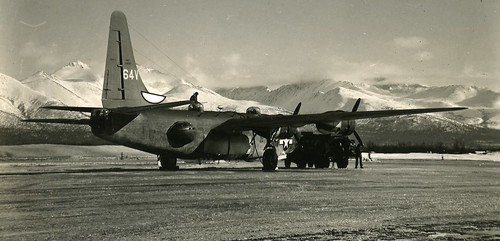
B-24, PB4Y2, Bomber in Alaska about 1945

Airplanes became a primary source of transportation in Alaska. The first flight was made in Fairbanks in 1913. WWI brought more planes to Alaska. In 1920, the military brought up army bombers from New York. This demonstrated that planes would be able to carry heavy loads across Alaska.

In 1924, float planes touched down in several towns in Alaska. By 1927, Alaska was maintaining 27 airfields. Because of high interest in flying, an aviation school was opened up in Fairbanks in 1928. More and more flights were being made throughout Alaska, commercial air service began, and the first publicly supported airfields were built.

Commercial flights began to increase inside and outside of Alaska. Because of aviation in WWII, limits were tested of airplanes and pilots started recognizing the potential of their planes. Eventually the airfields needed to be upgraded in order to keep up with the newly designed aircraft that needed more advanced landing strips. Air travel made for quicker and easier transportation of goods and people.

Communication systems in Alaska have developed considerably. In 1867, the first post office was authorized in Sitka. Mail service eventually expanded to the western and interior portions of Alaska. Mail routes consisted of reindeer, dog, horse, and railroad. Air mail began in Alaska in 1924, 5 years after it’s start in the lower 48.


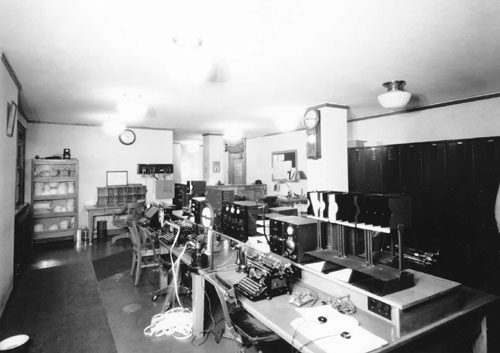
Alaska Communication System operations room - Ketchikan
Telecommunications came to Alaska between 1898 and 1900. The U.S. Army needed better communications between posts it had established to police the gold rushes to Alaska. Eventually there were telegraph lines connecting many cities and forts in Alaska. These lines were all at risk because of the weather and possible vandalism. The radio eventually took over the telegraph. No lines were needed because of the use of radio waves. 


The telephone was introduced to some communities as early as 1890. WWII resulted in the completion of the first overland telephone line from Alaska to the lower 48 which ran along the Alaska Highway.


One of the radar stations I saw in Nome. Very impressive!
Radar stations were used to provide warning of air attacks. Satellite communications were brought to Alaska as well, but their use was limited and expensive. It wasn’t until 1974 that satellite earth stations were located in rural villages which brought public telephones, emergency medical communication and television to remote areas. Broadcast radio and television become a part of the telecommunications. Something that I found interesting was that oil burners, milk shake mixers and hair dryers interfered with radio reception in Juneau. Television programs from outside the states had to be recorded and flown in and aired sometimes several weeks after their original date.


Examine Question:
Identify the three major railroads in Alaska history – Where? When? Why? Ownership? Current status?


 White Pass and Yukon Territory Railway:


Map
The White Pass and Yukon Territory Railway ran from Skagway to Whitehorse, Yukon Territory. The gold rush in Canada’s Klondike brought a higher demand for quicker transportation. The Railroad only took 26 months to build and was finished July 29, 1900. The total cost of the railway was over $10 million. It was the product of British financing, American engineering and Canadian Contracting. Tens of thousands of men and 450 tons of explosives  overcame harsh and challenging climate and terrain. The construction was directed by Contractor Michael Heney. The highest part of the track was 2,885 feet high passing through the summit of White Pass. There were 111 total miles of track. 20 miles in Alaska, 42 miles in British Columbia, and 58 miles in the Yukon Territory.


WP&YR Train

After the Gold Rush had subsided, the Railway was not used as often. It transported ore from Canada mines to Skagway. It also carried tourists who arrived in Skagway to Whitehorse. The railroad began to pick up more business during WW II. The owners loaned the railroad to the US government. It was used to haul war supplies to Whitehorse. After the war, the railroad went back to carrying tourist and freight. In 1970, a highway connected Whitehorse and Skagway. Operations were suspended in 1982 due to the mining collapse. In 1988, it reopened as a seasonal tourism operation. It is an International Historic Civil Engineering Landmark. It’s a destination shared with the Panama Canal, Eiffel Tower, and the Statue of Liberty. Today, it is Alaska’s most popular shore excursion, carrying over 360,000 passengers over tourist season in 2010.


I found this cite and it has a lot of really interesting information on it about the WP&YR.


The Copper River and Northwestern Railway:

Map
The Copper River and Northwestern Railway was built in hopes to exploit Southcentral Alaska’s copper deposits. Stakes were being claimed in the Copper River basin creating interest in building a railroad in Interior Alaska. The Bering River coal fields are right near where the Copper River empties into the Gulf of Alaska. This would provid fuel for the railroad. Cargo such as ore, gold and copper would provide a good profit for the railroad. The 196 mile railroad was completed in 1911 and ran between Cordova and Kennecott.


Construction of the Million Dollar Bridge
Construction of the railroad was difficult at times because of the weather and seasons. The bridge over the Copper River had to be built quickly in the winter months. This was the only time the water was frozen and workers could safely build the bridge.


The mine produced 70 percent pure copper in it’s deposits making a big profit for the railroad. By 1938, the mine was depleted and the railroad was abandoned. The line between Cordova and Cordova Airport was in operation during WWII. 60 miles of the line between Chitina and McCarthy were used for light tram traffic unit 1947.  Today, the railroad is not in operation.


The Alaska Railroad:


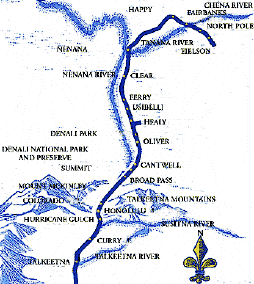
Alaska Railroad Route to Denali Park
Map
The Alaska Railroad went through a few different owners. It started as the Alaska Central Railroad (ACR) in 1902. It started in Seward and ended in Spencer. This route carried passengers, freight and mail to the upper Turnagain Arm. In 1909, the ACR was reorganized into the Alaska Northern Company (ANR). This company extended the track to just south of Girdwood. This company soon fell into financial troubles in 1915. The U.S. Government then purchased the ANR and moved the headquarters to Anchorage. The U.S. government established the Alaska Engineering Commission (AEC) to construct the Government Railroad.  The Alaska Railroad Commission bought the Tanana Valley Railroad, which fell into financial trouble in 1917. The Government railroad and the Tenana Valley Railroad were then connected in 1923.

This completed the now known Alaska Railroad. The railroad not only carried mail, lifestock, machinery and people, but alongside the tracks was the nation’s longest, publicly owned, telegraph line. Since the railroad stretched from Seward to Fairbanks, shipments were made within four to five days where before the railroad it took a month or more to complete.


image
Use during WWII
The railroad faced financial problems in 1925 with it’s expenses exceeding revenues. In the years just before WWII they finally started to see a turn around. During WWII, the railroad was needed to move huge quantities of military supplies. After the war, they ran into rehabilitation problems because of the heavy use during the war. Because of the pipeline and military construction boom, they were able to keep paying for repairs.


Today, the Alaska Railroad continues to support the Alaskan community. They are a powerful economic engine, hauling nearly 8 million tons of freight a year. They transport building products and support resource industries such as coal, oil and gas. They carry more than 500,000 travelers annually and create over 800 jobs for the Alaskan people. The railroad supports various organizations, communities, and charitable fund events along the railbelt. Spending supports nearly 1,900 Alaskan jobs and pumps over $83 million in payroll into the state annually. It works to improve the quality of life for residents along the railbelt by leasing land to communities at less than fair market value for parks, bike trails, and other public interest. (Information)


Evaluation:

I thought there was a lot of information in this Module, as usual. Very interesting. I was able to find some websites that had more information about current use of railroads and others with some good pictures. I was in Nome for the end of the Iditarod and was fortunate to see the radar station up close and personal. I was also fortunate to listen to our Arctic Cat driver talk about how his family came over for the gold rush and he grew up on a small gold mine that his family still owns.


Reviews:
I really like Shannon's blog. She has some good pictures and I like her links. Also, her blog is visually appealing.

Kristin did a good jog explaining the reasons why people moved up to Alaska.

Robin's blog had a lot of nice links for extended information. I also like the picture of miners and prospectors on the Chilkoot Trail. It's really good visual of just how many people there acutally were. Thanks for finding and sharing.


Sunday, March 11, 2012

Module 5 - American Period: Alaska's Economy


Essential Question:
What have been the major components of the Alaska economy during the American period of 1867-present?

This time period brought a lot of prosperity to the economy of Alaska. Alaska had a lot of natural resources that were being discovered and capitalized on. The early American economic ventures were pretty much the same as the Russians. The fur trade was a major resource of revenue as well as fishing and the discovery of minerals and oil. Because of these new discoveries, the resources were taken advantage of without concern of possible future depletion. It wasn't until there was a noticeable decrease in some of these natural resources that restrictions were set in place. And by then it was almost too late in some cases.


Group of men with bundles of Siberian fur pelts, Nome, August 1906
Fur Trade in Nome


The fur trade started to increase. The Russians mainly focused on a few types of furs. However, American traders were interested in a variety of different pelts. American trading companies took over Russian and British companies. For a short while, the new North American Trading and Transportation Company competed with the dominating Alaska Commercial Company who took over the Russian American Company. Both companies sold furs. Because of the competition among the two companies, prices were driven down and drove the quality up. Individual entrepreneurs also took advantage of the fur market. They would set up trap lines all over Alaska in hopes of selling good pelts. World War I caused prices of pelts to rise. America became the top seller of fur. New technology like planes and snow machines changed the pace of delivery.

Because of the high demand of pelts and the limited source of the supply taken for granted, the fur bearing animals began to decline drastically. This forced the government to require licenses and establish limits on trapping except to the Natives. Furs eventually lost their popularity once people were becoming more educated on the effects of trapping. Protecting the animals became a higher priority.


Fishing
Fishing was and still is a major revenue source for Alaska. It started off with a big push for salmon. That was the fish that was in highest demand early on. Fishing canneries were being built in a number of different places. Because of the high demand for salmon, there was a high demand for workers at the canneries. Many people were able to get jobs during this time. However, with time comes technology and machines eventually replaced the jobs of most of the people. Salmon fishing started broadening out to other types of fishing. Cod, crab, herring, halibut, and shrimp demands started to take off.

During WWI, demand was high for fish. After the war, however, demand fell. Canneries were forced to close. Also after the war, a major decline in the numbers of salmon was seen due to the abundance of commercial fishing. Just like it had with it’s trapping and hunting, Alaska had to require licenses and establish limits on fishing after it acquired statehood.

Whaling was a big interest back in the day. They developed shore whaling stations which mainly Eskimos were employed, mostly because of the their knowledge of the animal and mainly because they were cheap labor. They were paid with a years worth of flour, or riffles and bullets and other goods in exchange for 2 months work. The Eskimos started whaling for pay instead of for their own use. Seals and walrus also became a high interest. Walrus were easy to hunt because they would let hunters get close to them and they wouldn’t shy away from gunfire. They were all in very close vicinity to one another which made it easy to kill many at one time.

Whaling in Point Barrow, AK in 1935


Technology improved whaling. Steam powered ships were used instead of sailing. This improved navigation beyond a wind source. The Transcontinental Railroad shortened shipping time. Factory ships were introduced allowing companies to capture, haul in, and process the whale on board. Again, there was a huge decline in this resource which prompted the International Whaling Commission to be introduced and set quotas on whaling.

Aside from living sources of revenue, minerals also had a big part in Alaska’s economy. Large-scale mining operations were quickly developed. Mining camps and boom towns were developed all over Alaska based on the type of mining and the speed of extraction. Among the minerals excavated were: coal, copper, lead, zinc, platinum, and tin. The Gold Rush reached Alaska with Juneau, Nome, and Fairbanks being the sites of the major gold mining areas in Alaska.

Klondike/Yukon Gold Rush


Trans Alaska Pipeline
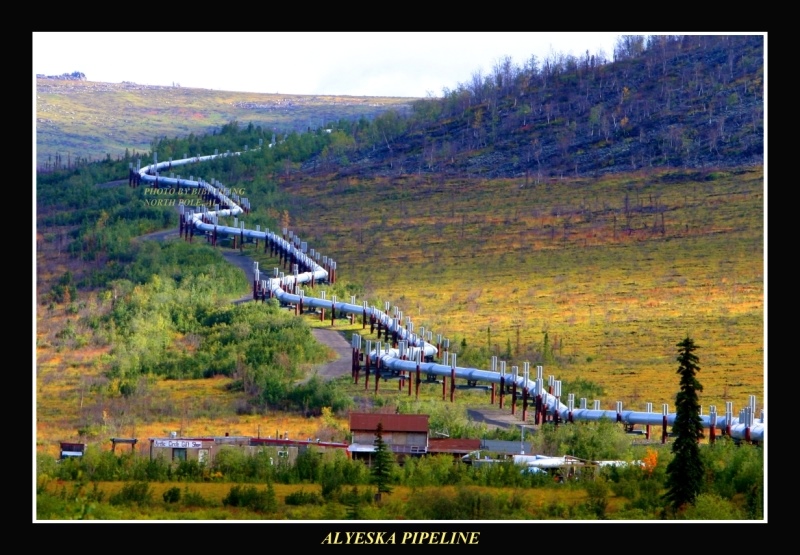
Oil is a huge part of Alaskan history and still is the biggest source of revenue today. Oil brings in 88% of Alaska’s revenue. In the early 1900’s, it was refined into kerosene. The pipeline was developed to carry the oil down from Prudhoe Bay to Valdez. The pipeline has created many jobs from building it to maintaining it. It also is responsible for boomtowns in Alaska.


Farming was expensive to get started. It didn't have a huge effect on the economy but was mainly used for local towns and villages. It was difficult to grow things because of the short season, permafrost, and high labor costs to name a few. Fresh fruits and vegitable were a delicacy when they were shipped in. Herding reindeer became very popular. The first reindeer were brought to Alaska in 1891 to aid in helping out the people do various field work and hauling as well as using their hides and eventually for food. On a side note, I have to admit that I enjoy a good reindeer dog every now and then. Lumber was also in high demand. Over the years, the timber industry had been putting out more board feet and had employed more people than in previous years. There were restrictions put on this too. Reserves were created to keep people from destroying the forests.

There were a lot of major components that went in to the Alaskan economy. I tried to keep each component as brief as I could but still ended up with a lot of information. One constant that I observed with every component was the inevitable need for limits. I guess hindsight is 20/20. I just can help but not understand how the people back then didn’t realize that they were depleting their resources faster than the resources could reproduce. But I guess there are still people doing the same thing today to make that extra dollar and totally disregard future effects.


Examine Question:
What is the current status of fur trapping, trading, whaling, and fishing?

Fishing (ID 1147) is still a major component of the Alaskan economy. In 2004, fisherman harvested about 5.4 billion pounds of seafood with a value of $1.2 billion from Alaska waters. The state seafood catch includes salmon, halibut, shellfish, herring and groundfish. Although groundfish are the majority of the catch, salmon, halibut, and shellfish are more valuble and bring in more revenue than groundfish. The state government manages fisheries within three miles of shore and the federal government manages fisheries beyond the 3 mile limit. Production of farmed fish is growing rapidly because fish farmers can meet the demands of the market with year round supplies. Farming also helps the cost stay consistant. Competition has increased because of globalization. Processing has been moved to other countries with lower labor costs, increasing consolidation, restructuring of distribution and more demands for new types of products. All of these factors are affecting the fishing industry.
Alaska Fishing


Trading and trapping is still a very important part of Alaska’s economy. People who live in small villages trap and hunt during the winter for money, especially if they live in isolated villages where there are very few jobs. Others do it for extra money and/or because it is part of their heritage and culture. Thousands of people buy trapping licenses each year. Alaska Fish and Game regulate trapping. I recently went to Bethel and some of the people (non-natives) that I met there were talking about their trap lines and that they needed to go check them and set up new ones. It was very interesting to hear them talk about it. Alaskan fur sewers are known around the world for their work. They use the money they earn for necessities. Most of the people in small remote villages use the skins/furs to keep them warm during the winter. The trappers pass down their skills from generation to generation. It teaches youth valuable skills and responsibility.


Trapping


Whaling
Whaling is not permitted in Alaska anymore except to the Natives. Natives have always hunted whales and it is a major part of their heritage. Whaling helps villages get through the winter months. They use every part of the whale, hardly any of it goes to waste. Any whaling done by Eskimos is monitored by the Alaskan Eskimo Whaling Commission (AEWC) and the National Oceanic and Atmospheric Association (NOAA). These organizations have a cooperative agreement with each other on whale hunting.  As stated in this article, Whalers are only allowed 75 strikes per whaling season. Hunters are concerned with ice thickness. The is becoming thinner than it used to be. because of this, whalers are not able to hunt the biggest whales they can find. They hunt the smaller ones because they know the ice will be able to handle the weight. This has become a problem because the smaller whales are not lasting through the winters. Another issue is the possible drilling for oil near Barrow. This cold drastically change the outcome of whaling for the village. The article also has a very interesting video about whaling you should definitely watch. Here is another video of the process of killing and pulling the whale out of the water. I definitely takes the cooperation of a lot of people.


Evaluation:

I feel like I keep repeating myself in these evaluations. I really enjoyed reading this module and learning about the economy of Alaska and how it's come along through the years. I enjoyed researching the information to answer the questions that I chose. I'm happy that I was able to find some short videos on whaling. I had always wondered how it was done and what it looked like but never sat down to research it.


Reviews:

I like how Gary used a lot of pictures to show what he was talking about. And he did a good job explaining the nature of cultural contact between the Europeans of Russian America and the Natives of Alaska.

Crystal did a good job providing links to further explain her answers.

I enjoyed reading Lane’s blog about the Creoles. It was very interesting how they came about and how they were viewed by the Russians. I also like how visual set up of the blog.